A seven-figure deal goes to a competitor. A customer with a green health score cancels at renewal. In the next leadership meeting, someone asks the obvious question: Why?
The room has plenty of data: NPS scores, health scores, call recordings, and a CRM field that says "Lost: Price." What it doesn't have is an answer.
That gap is the core problem with most voice of the customer programs. They measure how customers feel, but they rarely explain what customers decide. In B2B, the revenue lives in those decisions: to buy, to renew, or to leave.
This guide covers what voice of the customer means in B2B, why most programs miss the why, and how to build one that hears it.
The Quick Version
If you only have a minute, here's how a few key takeaways about VoC programs:
- Voice of the customer (VoC) is the practice of capturing, analyzing, and acting on what customers say about their needs, experiences, and decisions.
- Most VoC programs rely on scores and internally reported data. Both show what happened. Neither explains why.
- The strongest B2B programs listen at decision moments: purchase, onboarding, pre-renewal, and churn.
- Direct conversations, free of internal filters, are the most reliable source of the why.
- A VoC program earns its budget only when insights reach an owner and lead to visible change.
What is voice of the customer (VoC)?
Voice of the customer (VoC) is the practice of capturing, analyzing, and acting on what customers say about their needs, experiences, and decisions. It grounds product, go-to-market, and customer success strategy in the customer's own words instead of internal assumptions.
VoC can be as light as a one-click survey or as deep as an hour-long interview. Either way, the purpose is the same: replace guesses with evidence.
What is a voice of the customer program?
A voice of the customer program turns listening from an occasional project into an operating habit. It defines four things:
- Moments: where in the customer journey you listen
- Methods: how you listen at each moment
- Owners: who acts on each kind of insight
- Cadence: how often you collect, analyze, and share what you hear
Without that structure, feedback scatters across tools and teams, and no one owns the follow-through.
Why voice of customer looks different in B2B
B2B VoC depends less on volume and more on candor. Most VoC advice is written for consumer brands, where thousands of customers leave star ratings. B2B buying works differently in four ways that change how you should listen:
- Committees decide. One deal can involve a champion, an economic buyer, IT, procurement, and end users, each with a different stake.
- Every customer counts. You may close 200 deals a year, not 200,000 transactions, so each loss carries real revenue.
- The decisive conversations happen without you. Buyers build business cases, compare vendors, and debate objections in meetings your team never sees.
- Customers edit what they tell you. A buyer who chose a competitor rarely gives your rep the whole story. An unhappy customer may soften criticism to protect a relationship with their CSM.
What B2B teams need, then, is honest, specific feedback from the right people at the right moments.
The benefits of a voice of the customer program
A strong VoC program pays off in four places: win rates, retention, product bets, and positioning.
Listen to Krisha Nair, VP of Marketing at StackAdapt talk about how they used a VoC program to uncovered new revenue opportunities opportunities.
Higher win rates
When you learn why buyers choose you and why they don't, you can fix what's broken in product, pricing, positioning, and the sales process. In Clozd's 2025 State of Win-Loss Report, 63% of companies said formal buyer interview programs raised their win rates. Among programs running longer than two years, that figure rose to 84%.
Lower churn
Health scores and usage data can look fine right up until a customer leaves. Conversations surface what dashboards can't, like quiet frustration, competitive pressure, or a new executive with different priorities. Reputation's story, covered below, shows how this plays out.
Better product bets
VoC separates the features that drive buying and renewal decisions from the requests that are merely loud.
Sharper positioning
Customers describe their problems in their own language. When marketing and enablement teams borrow that language, it lands, because it came from the market in the first place.
If the payoff is that clear, why do so many VoC programs fall short of it?
5 voice of the customer methods
No single VoC method is best, because each answers a different question. The most useful way to compare them is by how much each reveals about why customers act. We call this the VoC Evidence Ladder.
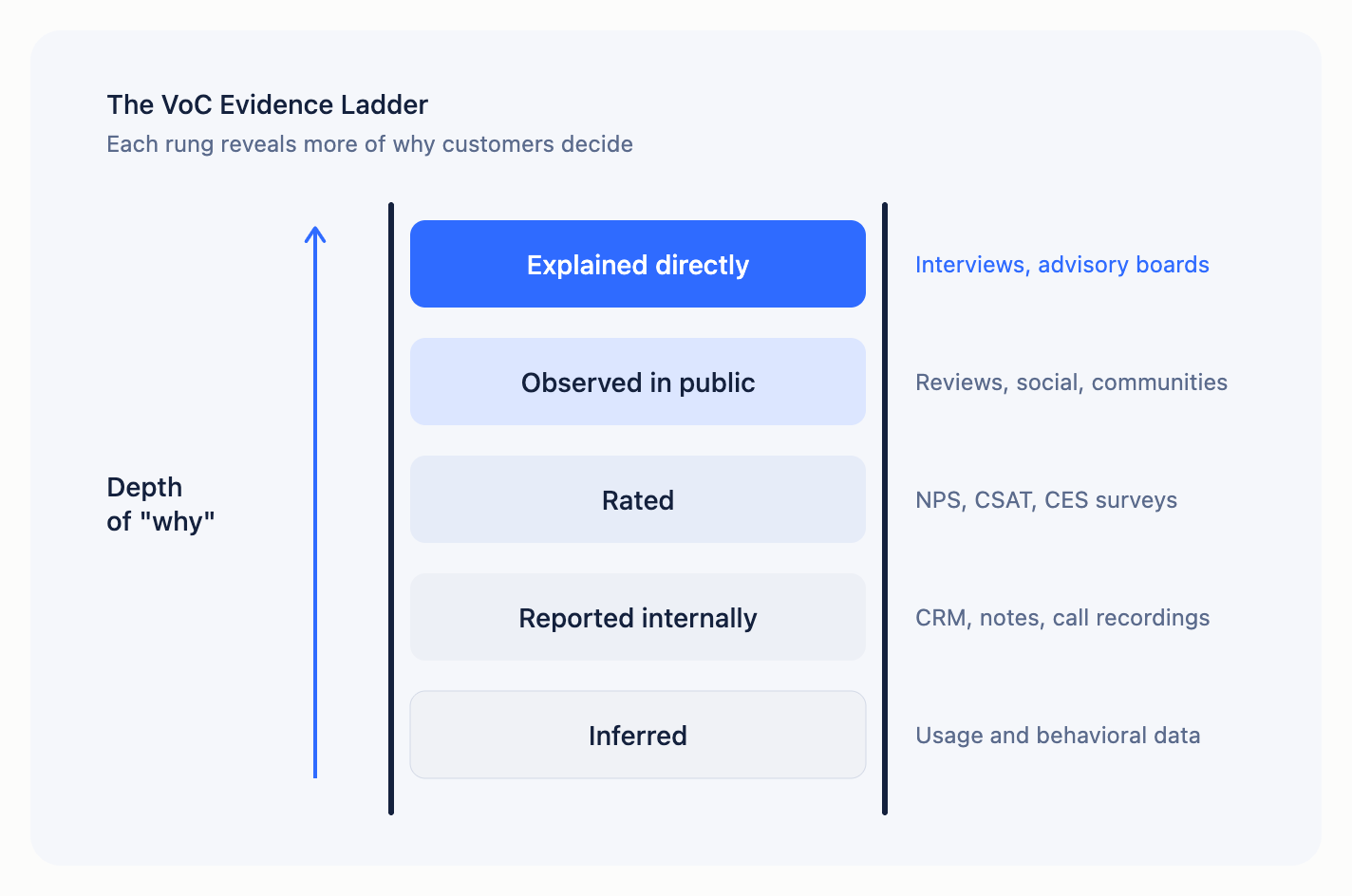
- Inferred: product usage, web analytics, and behavioral data. You see what customers do and guess at their reasons.
- Reported internally: CRM fields, rep and CSM notes, call recordings, and support tickets. The volume is high, but it's filtered through your team and limited to what customers said in the moment.
- Rated: NPS, CSAT, CES, and other surveys. They're easy to scale and trend but thin on context.
- Observed in public: review sites like G2 and TrustRadius, social media, and online communities. This feedback is candid and unsolicited, though it tilts toward extreme experiences.
- Explained directly: in-depth interviews and customer advisory boards. Here the customer tells you, in their own words, what drove the decision.
Most VoC programs crowd the bottom rungs and skip the top. The lower rungs are still useful, because surveys and analytics tell you where to look. But only conversations tell you what you'll find there, which is why buyer interviews beat B2B surveys for decision research.
What customer interviews add that other VoC data can't
Customer interviews add the one thing most VoC data lacks: the reasoning behind a decision. As we mentioned above, scores, CRM fields, and dashboards describe outcomes. A well-run interview explains them in five specific ways.
1. Interviews turn scores into stories
A score tells you something changed. An interview tells you what changed and why. When a customer rates you a 6, a 30-minute conversation can show whether the cause is the product, the implementation, the support team, or a new executive who prefers a competitor. With that context, teams can act on evidence instead of filling the gap with assumptions. The history of customer research shows how long companies have mistaken scores for understanding, and why conversations close that gap.
2. Interviews go straight to the source
Interviews replace your team's account of the customer with the customer's own. CRM loss reasons, rep notes, and CSM health assessments reflect what customers chose to share and how your team interpreted it. A direct, neutral conversation removes that filter.
The difference is large. When Clozd compared closed-lost reasons in the CRM with buyers' first-hand accounts, the two matched only 15% of the time. In the other 85%, the interview revealed a reason the CRM had wrong or incomplete. Interviews also replaced outcomes with actual reasons: 44% of CRM loss reasons were outcomes like "went with competitor," which buyer interviews could explain. See more of the lies your CRM tells you about your buyers.
3. Interviews reach the customers surveys miss
can reach the quiet middle, where churn risk often hides, and they let you follow up when an answer raises a new question. Surveys still have a role in tracking trends, and you can reduce survey fatigue with better design. But when you need to understand a decision, a conversation can go where a fixed questionnaire can't.
4. Interviews give every team the same story
Because an interview covers the whole decision, its findings are useful to product, marketing, sales, and customer success at once. A single buyer conversation might surface a missing feature, a confusing pricing page, a rep who oversold, and an onboarding gap. When those insights live in one shared place, each team can see how its piece fits the full customer journey, instead of treating symptoms in isolation.
5. Continuous interviews keep insights current
Ongoing interviews replace the annual research project with a steady stream of evidence. Markets, competitors, and buyer priorities shift faster than a once-a-year study can track. A continuous program gives you a baseline and shows how decision drivers change by quarter, segment, and competitor. With AI-moderated interviews, that stream can now cover far more customers than human interviewers alone could reach.
But don't interviews have their own problems?
They do, and the three most common objections are worth answering directly.
Objection 1: Twenty interviews isn't statistically significant.
That's true, and it isn't the goal. Interviews identify which drivers decide outcomes. Surveys and CRM data can then measure how often those drivers appear across the whole customer base. In B2B, where the population is small, themes typically start repeating within a few dozen conversations per segment. Our sample size guide covers the math.
Objection 2: Buyers rationalize their decisions after the fact.
Some do, which is why interview technique matters. A skilled interviewer, human or AI, asks about the sequence of events, not just the verdict. Questions like "When did you first consider a change?" or "What happened in the meeting where you cut the shortlist?" anchor answers in what actually happened. Interviews that happen within weeks of the decision also reduce memory drift.
Objection 3: Interviews are too expensive to run at scale.
Historically, that was the real constraint. However, today, AI-moderated interviews now run consistent, in-depth conversations at a fraction of the cost per interview. That lets teams reserve expert-led interviews for the highest-stakes deals and accounts.
How to build a voice of the customer program around decision moments
The highest-value feedback comes from the moments when customers make revenue decisions. Most VoC programs are organized by channel: the survey tool, the review sites, the support queue. Stronger programs are organized by decision moment, the points where a customer decides to buy, adopt, renew, expand, or leave.

1. The purchase decision (win-loss)
What you learn: why buyers chose you, a competitor, or nobody, and how they experienced your sales process, pricing, and product.
Who to ask: decision-makers and key influencers on recently won and lost deals, ideally within a few weeks of the decision.
Sample questions:
- What problem were you trying to solve, and what started the search?"
- How did you narrow the list of vendors?"
- What tipped the final decision?"
Find more in our guide to win-loss analysis.
2. Onboarding and post-implementation
What you learn: whether the customer is getting the value they were promised, and where the handoff from sales to customer success broke down.
Who to ask: project leads, admins, and the executive sponsor, shortly after go-live.
Sample questions:
- "How does the implementation compare with what you expected during the sales process?"
- "What would you need to see in the next 90 days to call this a success?"
Learn how to run a post-implementation review program.
3. Mid-journey and pre-renewal
What you learn: risk hiding behind healthy scores, room to expand, and shifts in the customer's priorities or stakeholders.
Who to ask: executive sponsors and power users, three to six months before renewal.
Sample questions:
- "How has your team's use of the product changed since you started?"
- "If you were choosing a vendor today, what would you look for?"
See why mid-journey feedback catches what health scores miss.
4. Churn
What you learn: why customers really left, which often differs from the reason logged in the CRM, and whether the door is still open. In Clozd's data, about 10% of churned accounts and closed-lost deals turn out to be legitimate win-back opportunities.
Who to ask: the decision-maker behind the cancellation, plus key users.
Sample questions:
- "When did you first start thinking about a change?"
- "What could we have done differently, and when?"
Read why churn interviews matter.
Ongoing: market and product research Not every VoC question is tied to a decision a customer just made. Before you invest in a new segment, product, or message, test whether it resonates.
Who to ask: current customers, lost prospects, and buyers in your target market. Sample questions:
- "How are you solving this problem today, and what's frustrating about it?"
- "If this capability existed, what would it replace in your current workflow?"
- "What would make this a priority for your team this year?"
Learn more about how product teams use VoC tools.
Voice of the customer in the age of AI
AI makes VoC more important, not less, because a model is only as accurate as the data it learns from.
Revenue teams now use AI to prioritize accounts, coach reps, forecast churn, and draft messaging. Most of what feeds those models is internal: CRM fields, call notes, support tickets, and dashboards. That's the same filtered data that caused the problems above. If a CRM loss reason is wrong, AI won't catch it. It will turn the error into a polished, confident conclusion and repeat it at scale.
Direct customer feedback acts as a truth layer that grounds AI in the real reasons customers buy, stay, and leave. As models become more widely available, the advantage shifts to the companies with the best inputs. Read why every AI stack needs a truth layer.
Voice of the customer examples
The companies below each had plenty of internal data and still benefited from direct conversations to explain their outcomes.
Zoom puts the deal at the center. Zoom had data flows from its sales, customer success, and partner teams, but those signals couldn't fully explain why deals were won or lost. With Clozd, the team built "Win-Loss 360," a program that gathers unbiased buyer feedback on every deal and shares it with product, marketing, and the rest of the company. Read the Zoom story.
Gong looks past the recorded call. Gong records every customer conversation, yet found that recordings showed only what happened, while buyer interviews revealed why. Co-founder and CPO Eilon Reshef has said that nothing replaces talking to customers directly. Read the Gong story.
Reputation finds the risk behind green scores. Reputation scored account health carefully and still faced surprise churn. Pre-renewal interviews let the team sort customers by real risk and build targeted save plays. In one case, an interview surfaced a bug that the team fixed within weeks, and the account renewed. Read the Reputation story.
Choosing voice of the customer tools
The right VoC stack covers every rung of the Evidence Ladder, not just the easiest ones to automate. Most companies already run several kinds of tools:
| Tool category | Best for | Limitation |
|---|---|---|
| Survey and feedback platforms | Scalable scores and trend tracking | Little context on why |
| Customer success platforms | Health scores, automation, and CS workflows | Mostly internal and behavioral data |
| Conversation intelligence | Analyzing sales and support calls | Captures only conversations your team attended |
| Review and social listening tools | Public perception and competitive mentions | Tilts toward extreme experiences |
| Interview-based VoC platforms (like Clozd) | Candid, in-depth feedback at decision moments | Requires customer participation |
If your stack produces plenty of scores and signals but still can't explain your biggest wins and losses, the top rung is the gap to close first.
Go deeper with Clozd
Your customers already know why they bought, stayed, or left. Most of them just haven't told your CRM, your survey, or your sales rep.
Clozd captures candid feedback at every decision moment, through expert-led and AI-moderated interviews, and turns it into insights every team can use.
Book a demo to see how Clozd can help your team.