




.svg)

Customer Feedback
Sales Leaders


Learn how we capture in-depth buyer feedback—and how it can transform your business.
Book a demoSummary
Key takeaways
AI can only work with what you give it, and most of what companies feed it comes from their own systems, not their customers. That means AI is now scaling internal assumptions faster and more convincingly than ever, turning bad inputs into confident but wrong conclusions. The fix is a truth layer: a continuous stream of direct, first-party customer feedback that grounds AI in the real reasons buyers choose you, walk away, renew, and churn. Because the companies with the best AI won't be the ones with the best models—they'll be the ones with the best inputs.
AI is changing how revenue teams work.
At Clozd we’re using it to prioritize our accounts, coach our sales reps, analyze our pipeline, identify churn risk, understand our customers, shape our messaging, and decide where to invest. And this is only the beginning.
The promise of AI is that it can take an enormous amount of information, find patterns humans would miss, and help us make better decisions, faster. But there’s a problem: AI can only work with what you give it.
Right now, most companies are feeding AI the same information they’ve always used to understand their business—CRM fields, dashboards, call notes, support tickets, pipeline data, product analytics, and internal documentation. That data is certainly useful. But when it comes to understanding why customers make the decisions they make, it has a significant blind spot: Most of it comes from us, not from the customer.
That distinction matters more now than it ever has. Unreliable inputs have always led to shaky decisions. AI simply gives us the ability to make those decisions faster, at greater scale, and with more confidence.
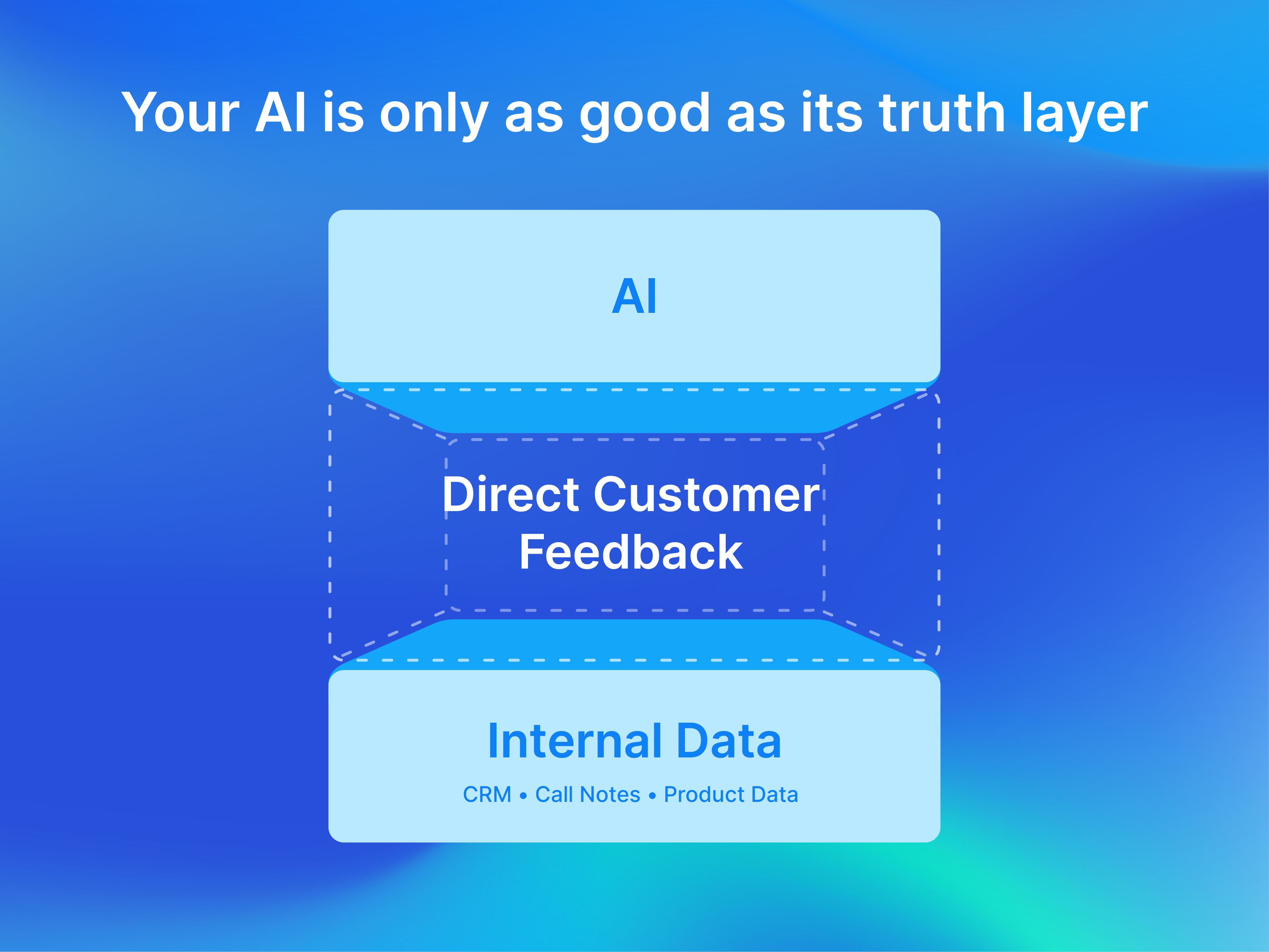
That's why I believe every enterprise AI stack needs a truth layer—a consistent source of direct, candid customer feedback that grounds AI in the actual reasons customers buy, walk away, renew, expand, and churn.
Without it, we risk using incredibly powerful technology to scale false narratives.
Imagine asking an AI tool a straightforward question: Why are we losing enterprise deals?
It analyzes your CRM, reviews opportunity notes, looks at sales calls and pipeline data, and gives you an answer. Maybe your pricing is too high. Maybe you’re missing a critical product capability. Maybe competitors are winning because of a particular feature. The answer is detailed, logical, and convincing.
But what if the underlying data is wrong?
AI doesn't know that a loss reason in your CRM was entered by a sales rep who spent 30 seconds—and not much thought—closing out an opportunity. It doesn't know that the buyer gave your salesperson a polite explanation instead of the real one. It doesn't know that the feature everyone blamed for the loss was actually a minor issue—and that the buyer really walked away because they weren't convinced your solution could deliver enough value to justify switching.
“The candidness we get from a third party has really allowed us to look at the information and pick it apart without our own emotion tied to it. It also eliminates that desire to want to please somebody or make sure you’re not ruining any relationships you might want in the future.”
—Deanna Ballew, SVP of Product at Acquia
AI can synthesize the information you give it, identify patterns within that information, and make recommendations based on those patterns. But it cannot manufacture customer truth that isn't there.
And if there’s an input problem, AI doesn’t solve it—it amplifies it.
We've had to deal with imperfect business data forever. Every revenue leader knows their CRM isn't a perfect representation of reality.
Before AI, however, there was much more friction between that data and the decisions we made with it. A leader had to pull a report, interpret it, discuss it with their team, weigh different perspectives, and decide what to do. AI removes much of that friction, which is part of what makes it so powerful. It's also what makes unreliable inputs more dangerous.
An AI system can now take a flawed explanation from your CRM, combine it with thousands of other internal signals, package everything into a compelling narrative, and recommend exactly what your team should do next.
Bad input —> Impressive analysis —> Wrong conclusion
And because the output sounds authoritative, the organization can start moving quickly around a problem that doesn't actually exist. Your product team starts building. Marketing changes the message. Sales modifies the pitch. Customer success redesigns the playbook. Leadership reallocates budget.
AI has just helped the entire organization move faster—in the wrong direction.
That's the risk I think revenue leaders need to pay more attention to. While most companies are scrambling to figure out how to use AI, the real question is whether you can trust the information you’re giving it.
This matters across your entire company—but the stakes are particularly high for revenue teams, because winning is getting harder.
The buying journey is becoming less predictable. Traditional demand-gen playbooks are changing. AI is altering how buyers research products and evaluate vendors. Companies are scrutinizing spending more closely, and buying committees remain complicated.
The old funnel was never as linear as we liked to pretend it was, but it feels even less linear today.
For revenue leaders, that means every real opportunity is even more valuable. If you have a chance to win a deal, you need to understand the actual factors that cause buyers to choose you. If a customer churns, you need to understand what really changed. If an account expands, you need to understand what created enough value for them to invest more. If a competitor starts beating you, you need to know why.
Increasing your batting average depends on learning from every one of those decisions. And that's difficult if the information informing your AI comes primarily from your own organization.
Sales reps have a perspective. Customer success managers have a perspective. Product teams and executives have perspectives too. Those perspectives matter, but they're still perspectives.
The customer is the one who made the decision.
“Win-loss data is the ultimate customer-obsession metric. When you’re making a decision, it doesn’t matter what you think—it matters what your customers say."
—Matt Nelson, VP of Product Marketing & Growth at AuditBoard
If we want AI to help us understand that decision, we need to give it access to the customer's exact explanation.
This is where I think many enterprise AI strategies are still missing something. We've spent enormous amounts of time thinking about the intelligence layer: Which models should we use? Which workflows should we automate? Which agents should we build?
Those are important questions. But we also need to think about the truth layer underneath that intelligence.
A truth layer is a continuous stream of verified, first-party feedback from the customers and prospects making the decisions your business cares about. It isn't another score, another internal interpretation, or another dropdown field in Salesforce. It's actual conversations with customers about why they made their decision.
Those conversations contain context that structured business systems simply don't. And once that context becomes accessible to AI, the value compounds.
Your AI goes beyond analyzing what happened and begins to understand why it happened.
None of this means CRM data, product analytics, support tickets, or call transcripts stop mattering. It’s quite the opposite—you now have the opportunity to bring these sources together and give your AI a more complete picture of reality.
"We needed to get an external perspective, and we wanted to hear from our customers in an unbiased way. So we partnered with Clozd to build the ‘Win-Loss 360’ program—and it's worked very, very well for us.”
—Leo Boulton, Head of Product, Solutions & Industry Marketing at Zoom
Your CRM can tell you that a deal was lost. Your product data can tell you that adoption declined. Your support system can tell you that your ticket volume increased. Your forecast can tell you that an account is at risk. Those systems are very good at telling you what happened.
Direct customer feedback helps explain why.
Think about the truth layer as an insurance policy on the rest of the information your AI is consuming. It gives AI an outside-in perspective it can't get from internal systems alone.
The truth layer doesn't replace the rest of your stack. It keeps the rest of your stack honest.
Most conversations about AI focus on getting better answers. But when AI has access to richer customer context, it also helps leaders ask better questions.
Instead of asking, “What are our top loss reasons?” you can ask, “Why do enterprise buyers who initially prefer us ultimately choose a competitor?”
Instead of, “Which customers are at risk?” you can ask, “What themes appeared in customer conversations six months before similar accounts churned?”
Instead of, “What features are customers requesting?” you can ask, “Which product gaps are actually affecting purchase, renewal, and expansion decisions?”
That shift matters. Rather than simply asking AI to summarize what happened last quarter, you can start uncovering the real reasoning behind thousands of customer decisions. That's a very different level of intelligence—and it's only possible if the underlying customer truth exists in the first place.
We're still early in the enterprise AI transition. Models and tools will improve, and agents will become more capable. Much of the technology available to one company will quickly become available to everyone else.
So I'm not convinced long-term advantage comes simply from having access to better AI.
A much more interesting question is: What does your AI know that everyone else's AI doesn't?
Every company can buy powerful models. Not every company has built a continuous system for capturing what its customers actually think and why they make the decisions they make.
That customer truth is proprietary. It's specific to your buyers, your product, your competitors, your market, and your customer experience. And when you make that truth available to AI, you're giving increasingly powerful technology something uniquely valuable to work with.
That's where I believe the opportunity is.
Revenue leaders are under enormous pressure to move faster with AI right now. I understand why. I feel it too.
But speed isn't particularly useful if we're scaling the wrong ideas.
Before we automate another workflow, deploy another agent, or ask AI to tell us what our customers want, we should make sure it has access to the people who actually know: our customers.
Because if we're going to trust AI to influence decisions about where we invest, what we build, how we sell, and how we grow, we need to give it something better than our own version of the story.
We need to give it the truth.

Clozd is consistently ranked as the best win-loss solution for ROI, ease of use, and quality of support—by the revenue leaders who use our platform every day.






.svg)