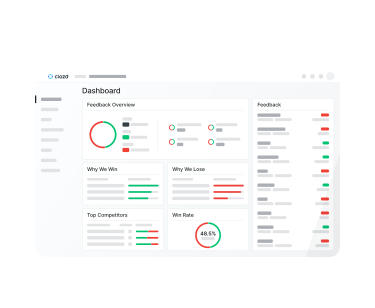
Not all voice-of-customer tools are created equal. Some collect survey responses. Others analyze customer interactions, track sentiment, or uncover the reasons behind buying decisions.
The right tool depends on what you want to learn from your customers.
A CX lead wants signals from every store and app. A product manager wants support tickets sorted by theme. A contact center director wants to hear the tone on every call. A sales leader wants to know why deals are lost.
When choosing a solution, the best approach is to start with the question you need answered. Below, we walk through seven voice-of-customer tools, what each does best, and who it's built for.
A quick note: Clozd publishes this guide, and we've included ourselves on the list. We've tried to evaluate every tool on its genuine strengths, because most teams end up using more than one.
Best voice-of-customer software at a glance
Tool
Best for
VoC approach
Clozd
Revenue, product, and sales leaders diagnosing win, loss, and churn drivers
Independent buyer and customer interviews + AI analysis
Qualtrics XM
Global enterprises needing advanced statistical modeling and strict data governance
Survey-led experience management platform with predictive analytics
Medallia
Large omnichannel enterprises analyzing real-time signals across locations, digital, and contact centers
Enterprise experience platform with AI text and speech analytics
InMoment
Regulated industries (healthcare, finance, utilities) that want hands-on CX advisory
CX platform + advisory services
Chattermill
Digital-first and product-led brands analyzing tickets, chats, and app reviews
AI feedback analytics with aspect-based sentiment
Sprinklr Insights
Multinational consumer brands tracking brand health and competitor perception
Social and digital listening
Verint
Enterprise contact centers extracting tone, emotion, and root causes from calls and chats
Speech and interaction analytics
What is voice-of-customer software?
Voice-of-customer (VoC) software collects feedback from customers and buyers, analyzes it, and helps teams act on it. Some tools specialize in collection. Others specialize in analysis: sentiment, themes, root causes. At the core, the best VoC analytics software ties what customers say to decisions your teams can make.
The category is wider than most buyers expect. The tools in this guide fall into five groups, and each answers a different question:
Interview-based buyer intelligence explains why buyers choose, leave, or stay by talking to them directly.
Enterprise experience management (XM) platforms collect and analyze feedback at scale across surveys, digital channels, and locations.
Feedback and text analytics tools unify unstructured feedback from tickets, chats, and reviews and tag it by topic and sentiment.
Social and digital listening tools track unsolicited customer opinion, brand health, and competitor perception outside your own channels.
Contact center interaction analytics extract tone, emotion, and root causes from calls and chats.
A company with 400 high-value accounts faces a different problem than a consumer brand with four million app users. Large-scale tools find patterns in volume. Interview-based tools find the reasons behind individual decisions. Most mature teams run at least one of each. (For more, see our Voice-of-CustomerVoice of Customer guide).
The 7 best voice-of-customervoice of customer tools
1. Clozd
Best for: B2B revenue, product, and sales leaders diagnosing win, loss, and churn drivers through in-depth buyer interview intelligence.
Most voice-of-customer tools analyze existing feedback from surveys, support tickets, reviews, and customer interactions. Clozd takes a different approach.
Through candid buyer and customer interviews and purpose-built AI, Clozd helps B2B teams understand the real reasons behind wins, losses, retention, expansion, and churn. These insights help sales, marketing, product, and customer success teams make better decisions and drive measurable business outcomes.
Customers aren't always comfortable sharing candid feedback directly with their sales reps or account managers. Independent interviews help uncover the real reasons behind their decisions, including frustrations, unmet expectations, and competitive considerations.Most voice of customer tools work by listening. They collect surveys, read tickets, scan reviews, and analyze calls, then look for patterns in what customers already say. That works well when the question is what or how often.
Clozd sits at the other end of the category. Instead of listening for signals, it asks. Independent, third-party interviewers talk with buyers and customers, and Clozd turns those conversations into structured insights for sales, product, marketing, and CS. It answers the question the other tools raise: why.
The independence piece is key. Buyers are rarely candid with the rep they just turned down. A neutral interviewer gets the real story: the pricing objection that was really a trust gap, the integration that never worked, the champion who left mid-contract.
Key VoC features
Independent buyer and customer interviews: Expert interviewers run win-loss, post-implementation, CX check-in, and renewal-stage interviews, so you hear from customers across the whole journey rather than at one touchpoint.
AI Interviewer: Clozd's AI Interviewer asks adaptive follow-up questions to pre-recorded questions or fully moderates the interview so teams can hear from far more customers than a human-only program allows.
AI-powered analysis: Automatic transcription, summaries, and suggested Decision Drivers help teams spot patterns across hundreds of interviews without manual tagging.
Role-based reporting and Smart Tags: Route the right insights to the right team, from product roadmap themes to sales coaching moments.
Integrations and AI workflows: Clozd MCP connects customer feedback directly to the tools your teams already use, including Claude and ChatGPT through official, easy-to-set-up connectors. Additional integrations with Gong and automated Workflows help teams put customer insights to work.
Pros
Answers the why behind decisions, not just the what
Third-party interviews produce more candid feedback than internal outreach or surveys
Built for B2B, where each account and each deal carries real revenue
Trusted by B2B teams including Microsoft, Toast, Gong, and Blue Cross Blue Shield
Limitations
Focused on direct buyer and customer feedback rather than broad social listening or contact center analytics
Interview programs build depth over time, so they complement real-time alerts but don't replace them
Pricing: Custom, based on program scope. Contact Clozd for a quote.
Best for: Global enterprises requiring advanced statistical modeling, strict data governance, and cross-departmental VoC scale.
Qualtrics is an enterprise experience management platform focused on collecting and analyzing customer, employee, and market research data.
Key VoC features
Qualtrics iQ analytics: A suite of AI and statistical tools including Text iQ for open-text analysis, Stats iQ for automated statistical testing, Predict iQ for predictive modeling, and Driver iQ for surfacing root causes of broken experiences.
Suites for different teams: Since April 2024, Qualtrics has organized its offering into XM for Customer Experience, XM for Employee Experience, and XM for Strategy & Research.
Survey depth: More than 100 question types, advanced logic, randomization, scoring, and translation.
Experience Agents: AI agents that help teams act on insights faster.
Pros
Statistical depth that few VoC platforms match, in a form non-statisticians can use
Meets strict governance, security, and compliance requirements
One platform can serve customer, employee, and market research programs
Limitations
Text analysis tied to Qualtrics data may need additional products to cover tickets, calls, and social content
Full value takes training or dedicated analysts
Pricing: Available on request
3. Medallia
Best for: Large omnichannel enterprises analyzing real-time customer signals across physical locations, digital touchpoints, and contact centers.
Medallia helps organizations collect and analyze customer feedback across physical locations, digital channels, and contact centers a store, an app, a website, a call center. It pulls those signals into one platform, so a frontline manager, a regional lead, and an executive each see the slice that matters to them.
Key VoC features
Medallia Athena AI: Machine learning and generative AI across the platform, including Text Analytics for survey comments, social posts, and call center notes.
Medallia Speech: Speech-to-text and speech analytics that bring call data, including sentiment, into the same platform as survey and digital feedback.
Digital experience analytics: AI summaries of digital sessions highlight key behavioral events without watching a replay.
Hierarchy-based access: Insights and permissions are modeled on your org structure, so a store manager and a CX executive each see what's relevant.
Pros
Strongest where feedback arrives from many channels and many physical locations at once
Real-time alerts and frontline workflows make it easy to act on feedback quickly
Long track record with large enterprises, including contact center use cases
Limitations
Built for enterprise scale, so smaller B2B teams may not need that much platform
Large deployments may need dedicated admin and program resources
Pricing: Available on request
4. InMoment
Best for: Regulated industries (healthcare, finance, utilities) pairing customer journey analytics with hands-on CX advisory services.
InMoment pairs a full experience platform with a services team that helps run the program. This approach can be especially valuable for organizations with complex compliance and data management requirements.
Key VoC features
XI (Experience Improvement) Platform: Collects feedback from surveys, reviews, support tickets, and conversations, then runs AI and text analytics across structured and unstructured data.
Closed-loop case management: Built-in workflows route issues to the right team for resolution.
Advisory and managed program services: Experts help with program design, data management, and ongoing survey and dashboard management.
Industry solutions: Packaged approaches for healthcare, financial services, utilities, retail, and other sectors.
Pros
Hands-on services reduce the burden on internal CX teams
Deep experience in regulated, compliance-sensitive industries
Connects feedback from many sources, including reviews and conversations
Limitations
Implementation takes real time and professional services support
The scope can be broader than needed for teams that want a single-purpose feedback tool
Pricing: Available on request
5. Chattermill
Best for: Digital-first and product-led brands automating aspect-based sentiment analysis across support tickets, chat logs, and app reviews.
Chattermill doesn't ask customers for feedback. It reads what they already write: support tickets, chats, app store reviews, surveys, social posts. Then it turns that text into themes your product and CX teams can rank. If feedback pours in daily, Chattermill shows you quickly what's driving frustration.
Key VoC features
Lyra AI: Chattermill's AI engine tags themes and scores sentiment at the aspect level, so you see which feature or touchpoint drives a rating, not just whether a comment was positive or negative.
Unified feedback sources: Connects dozens of sources, including Zendesk, Intercom, Salesforce, app stores, review sites, and survey tools.
Business metric links: Ties themes to NPS, CSAT, CES, and churn so teams can rank issues by impact.
MCP server: Lets teams bring feedback intelligence into AI agents and assistants.
Pros
Fast time to insight on high volumes of unstructured text
Aspect-level sentiment pinpoints specific issues instead of broad themes
Suits product-led and digital-first teams with always-on feedback
Limitations
It's an analysis layer, so it can't ask follow-up questions or explain the reasoning behind a single decision
Value depends on feedback volume, which makes it a better fit for large user bases than small, high-value account bases
Pricing: Available on request
6. Sprinklr Insights
Best for: Multinational consumer brands tracking unsolicited customer sentiment, brand health, and competitor perception across digital channels.
Sprinklr Insights monitors unsolicited customer feedback across social media, review sites, forums, and other digital channels.—and then uses AI to surface themes, sentiment, and anomalies. For a consumer brand working across many markets and languages, it shows how perception forms in real time.
Key VoC features
Social listening: Monitors conversations across social, digital, and traditional media channels, and surfaces themes, trends, and anomalies automatically.
Competitive insights and benchmarking: Compares your brand with competitors on engagement, share of voice, and sentiment, with prebuilt dashboards.
AI-based issue detection and alerts: Flags emerging issues and sentiment anomalies early to help teams manage reputation risk and crises.
Conversational AI analysis: Ask questions about trends and brand health in plain language instead of building queries by hand.
Pros
Wide channel coverage, built for global brands operating in many languages
Strong competitive and brand-health benchmarking
Part of a broader platform, so insights can flow into marketing and service workflows
Limitations
Public conversation skews toward consumer brands. B2B buyers rarely discuss vendor decisions in public, so this approach captures less of the picture for B2B SaaS
Pricing: Available on request
7. Verint
Best for: Enterprise contact centers extracting tone, emotion, and operational root causes from call recordings and chat interactions.
Customer calls and chats contain valuable information about customer experiences, frustrations, and expectations. Verint captures that signal at contact center scale. Its speech and text analytics transcribe and analyze each interaction, so operations leaders can see why customers call, how they feel, and what drives repeat contacts.
Key VoC features
Speech Analytics: Speaker-separated transcription of recorded calls, with AI-driven themes, sentiment, and push-button root cause analysis.
Text Analytics: Analyzes web chat, email, social messages, and call notes, with contact center metrics like handle time and message count.
Sentiment and emotion detection: AI bots score sentiment across interactions, including emotion and intent.
Quality management and coaching: Connects analytics to automated quality scoring and agent coaching, so insights turn into frontline improvement.
Pros
Analyzes every interaction instead of a small manual sample
Serves compliance, quality, and efficiency goals alongside VoC
Mature tooling for large, high-volume contact centers
Limitations
Focused on the contact center, so it won't capture buyers who never call support or customers who've already left
Pricing: Available on request
How to choose the right voice-of-customer software
As we mentioned at the start of this article, the best way to choose your platform is to get clear on the question your team is looking to answer, then match it to the tool.
If your question is...
You need...
Consider
"Why do buyers choose us, pick a competitor, or leave?"
Interview-based buyer intelligence
Clozd
"How do we run a governed, statistically rigorous program across the enterprise?"
Enterprise XM platform
Qualtrics XM
"How is the experience performing across stores, digital, and contact centers right now?"
Omnichannel experience platform
Medallia
"How do we run VoC in a regulated industry with expert help?"
Platform plus advisory services
InMoment
"What are customers saying in tickets, chats, and app reviews?"
Feedback and sentiment analytics
Chattermill
"How is our brand perceived compared with competitors?"
Social and digital listening
Sprinklr Insights
"What is driving calls and frustration in our contact center?"
Interaction analytics
Verint
What about the best AI voice-of-customer?
AI plays a different role in every voice-of-customer tool. Some use it to analyze survey responses, classify customer feedback, or identify trends across large volumes of data.
Clozd uses purpose-built AI agents to help conduct interviews, analyze conversations, and uncover insights that might otherwise go unnoticed. And through Clozd MCP, teams can connect that customer intelligence directly to AI tools like ChatGPT and Claude.
The question isn't which tool has the most AI. It's which tool helps you better understand your customers and make more informed decisions.
B2B SaaS teams have fewer customers, longer sales cycles, and bigger contracts. Each lost deal or churned account carries real revenue, and a survey score rarely explains it. Interview-based insight answers the why. Many teams then add one high-volume tool, such as Chattermill for support and product feedback or Qualtrics for survey programs, to cover the what and how often.
Find the voice-of-customer tool that answers your question
The best voice-of-customer software answers the question you're asking.
If you want to understand why customers buy, stay, expand, or leave, you need to hear directly from them. Clozd combines candid customer interviews with purpose-built AI to uncover the reasons behind those decisions and help your teams act on what they learn.If you want to know why buyers choose you, pick a competitor, or leave after the sale, you need the conversation. That's where Clozd fits: independent interviews that surface the real reasons behind decisions and put them in front of the teams who can act.
What's the best software for voice-of-customer analytics?
It depends on what you're analyzing. Chattermill and Medallia handle large volumes of text. Qualtrics handles statistical analysis of survey data. Verint handles calls and chats. Clozd analyzes in-depth buyer and customer interviews to explain why decisions happen.
What's the difference between VoC software and survey software?
Survey software collects structured answers to questions you write in advance. VoC software casts a wider net: surveys, yes, but also interviews, tickets, calls, reviews, and social data, plus analytics that find themes and root causes. Surveys tell you how many people feel a certain way. Conversations tell you why. (See Why Buyer Interviews Beat B2B Surveys.)
Do I need more than one VoC tool?
Often, the answer is yes. Each tool here works best with one type of feedback, and none covers every channel well. A common pairing: a high-volume tool for the what and how often, plus interview-based insight for the why.
How do B2B companies collect voice-of-customerdata?
Most combine sources: buyer and customer interviews, surveys, support tickets, call recordings, and CRM or product data. B2B teams lean on interviews because they have fewer accounts and each one matters. (More in Who Should We Be Gathering Feedback From?)
Clozd is consistently ranked as the best win-loss solution for ROI, ease of use, and quality of support—by the revenue leaders who use our platform every day.
7 years in a row
“If you want data-driven insights to fuel your strategy, Clozd is a no-brainer. The upfront investment is quickly dwarfed by the immense value it brings in the form of actionable intelligence and competitive advantage.”
Dan Bolton | Vice President of Corporate Marketing