




.svg)


Industry
Ready to win more deals?
Learn how we capture in-depth buyer feedback—and how it can transform your business.
Book a demoStrategic overview:
This post explores how direct customer feedback—captured via interviews and surveys—reveals high-impact insights at the four essential customer journey touchpoints: Win-Loss, Post-Implementation, Customer Experience, and Churn/Retention. If you’re responsible for revenue growth, retention, or product strategy, this is your blueprint to build customer-centric strategies that turn feedback into tangible business impact.
Why Customer Feedback Matters at Key Journey Touchpoints
B2B organizations now operate in a world where growth is driven by their ability to tune into the real voice of the customer. Unfortunately, too many teams still rely on CRM fields or surface-level surveys, leaving critical decisions to guesswork. But when you embed focused, direct feedback at each key customer journey moment, you get clarity—and an advantage your competitors can’t match.
The Power of Customer Feedback in B2B Decision-Making
Every major business initiative—whether it’s ramping win rates, boosting retention, or building products customers love—hinges on understanding your buyers and existing customers. Here’s why unbiased, direct feedback beats internal assumptions every time:
- Retention & Growth: The cost of acquiring a new customer is 5x higher than retaining an existing one. According to the Clozd Guide to Customer Retention, organizations that proactively collect feedback through interviews uncover pain points and win-back opportunities that would otherwise be missed.
- Competitive Differentiation: Clozd’s 2025 State of Win-Loss Analysis shows 84% of companies with ongoing win-loss programs for over two years reported higher win rates—proof that direct insight from buyers is a revenue lever.
- Eliminating Blindspots: CRM data is wrong as much as 85% of the time when it comes to closed-lost reasons (Clozd 2024 State of Win-Loss Analysis). The real reason you win or lose a deal, retain or churn a customer, won’t be found in a checkbox—it comes from your buyers and customers themselves.
Framework: The Four Critical Touchpoints
Mapping Customer Touchpoints: Where Feedback Drives Value
No journey map is complete without identifying where feedback should be collected and what questions matter most. A well-designed map does more than visualize the customer lifecycle; it prescribes exactly where targeted feedback will unlock business outcomes.
What Are Customer Touchpoints?
Customer touchpoints are the key interactions a buyer or customer has with your company—from initial discovery through renewal or departure. In B2B, these go far beyond a simple sales process. Seven typical journey stages include:
- Discovery (first brand impressions)
- Evaluation (consideration, market research)
- Purchase Decision (win-loss moment)
- Onboarding/Post-Implementation
- Engagement/Ongoing Experience
- Renewal/Expansion
- Churn/Exit
Feedback is essential at each stage, but the four touchpoints below consistently deliver the most ROI for B2B leaders:
- Win-Loss
- Post-Implementation
- Ongoing Experience (“Stay”)
- Churn/Retention
Matching Feedback Methods to Touchpoints
A one-size-fits-all approach doesn’t work. Here’s how to match collection methods to each journey stage:
- Surveys: Great for high-volume pipeline coverage and trend-spotting but lack depth. Best used in conjunction with interviews.
- Live Interviews: Unlock deep context, emotion, and specifics—ideal for win-loss, churn, and onboarding moments.
- Asynchronous Interviews (AI-led or recorded): Increase participation and flexibility, especially at scale or with hard-to-reach buyers.
- In-Product / Onboarding Surveys: Collect real-time insights on product usage barriers or feature adoption post-sale.
- Third-Party Expert Interviews: Remove bias, ensure candor (Clozd research shows former customers are significantly more open with third parties than internal teams).
The Four Critical Touchpoints: Tactics and Questions That Get Real Answers
At each critical touchpoint, focus and specificity are key. Below are proven tactics and sample questions you can start using immediately.
Win-Loss: Uncovering Decision Drivers
Win-loss interviews are the gold standard for understanding how buyers navigate complex decisions. Success here isn’t just about why you lost, but why you win.
Approach:
- Interview both new customers and those who chose a competitor, ideally within 30 days of the decision for maximum recall.
- Use a neutral third party for objectivity and candor.
Example Questions:
- What were your primary objectives in considering solutions like ours?
- Which factors most influenced your decision?
- How did our solution compare to others on your shortlist?
- What could we have done differently to change the outcome?
- Was there a moment that was pivotal in your evaluation?
Clozd ROI: 84% of mature win-loss programs report win-rate increases, and 10% of “closed-lost” deals are actually win-back opportunities when surfaced with the right follow-up (See Clozd 2025 State of Win-Loss Report).
Learn more about Win-Loss Analysis
Post-Implementation: Ensuring Successful Onboarding
Deep feedback after implementation helps you spot friction points, surface early adoption challenges, and set new customers up for renewal.
Approach:
- Schedule interviews and/or targeted surveys at 30, 60, and 90 days post-implementation.
- Listen for both end-user and decision-maker perspectives.
Example Questions:
- How did you feel about the onboarding and training experience?
- Did anything not meet your expectations? What was confusing?
- What were the biggest wins in your rollout? The pain points?
- How likely are you to recommend our solution to a peer, and why?
“Retention-focused efforts—like post-implementation feedback—offer higher ROI because they tap into an already engaged audience.” (Clozd Customer Retention Guide)
Learn more about Post-Implementation Feedback
Ongoing Experience: Monitoring Relationship Health
Regular touchpoints ensure you’re not blindsided by churn. “Stay” interviews and short pulse surveys capture current sentiment and flag risk early.
Approach:
- Schedule “stay” interviews with a mix of high-value, at-risk, and stable accounts each quarter.
- Use NPS or CSAT surveys as directional signals; double-click with interviews for actionable specifics.
Example Questions:
- On a scale of 1–10, how would you rate your satisfaction, and why?
- What’s the most valuable aspect of our partnership?
- Are there any unmet needs or issues holding you back?
- Is there something we could do to deepen this relationship?
Real-World ROI: Xactly nearly eliminated high-value churn by expanding from lost-customer interviews to proactive “stay” interviews with all current customers (See Clozd Guide to Customer Churn).
Learn more about Customer Experience Feedback
Churn/Retention: Learning from Departing Customers
Losing a customer stings, but it’s also a goldmine of insight—if you’re willing to ask the right way.
Approach:
- Engage immediately after notice of cancellation for maximum candor.
- Use third-party interviewers—Clozd has found clients are significantly more open this way.
Example Questions:
- What drove your decision to end our partnership?
- Was there a specific event or trigger?
- Did you consider other solutions before leaving?
- What, if anything, might encourage you to return in the future?
Case Insight: Clearbit achieved a 10% increase in gross retention by systematically using feedback from exit and “stay” interviews to inform roadmap priorities (See Clozd 2025 State of Win-Loss Report).
Learn more about Churn Analysis
Integrating Customer Feedback into Journey Mapping & Business Improvement
Gathering feedback is just the beginning. The true value comes when you connect those insights to your journey map—and then drive concrete changes in your business practices, products, or go-to-market motion.
Closing the Loop: Turning Feedback into Measurable Impact
- Step 1: Integrate feedback data with your journey map. Use platforms like Clozd to segment and display customer feedback by stage, persona, and outcome.
- Step 2: Share findings widely. Push insights to sales, product, marketing, and leadership via Slack, dashboards, or regular debriefs.
- Step 3: Prioritize action items. If multiple lost deals cite a missing integration, rally product and CS to close the gap. When onboarding friction surfaces, empower the CS team to revamp the process and track improvement.
- Step 4: Measure outcomes and report back. Iterate based on NPS, win rate, or renewal metrics.
For more on closing the VOC feedback loop
Organizations that democratize feedback—making it visible to all key teams—see a higher win-rate impact (Clozd Definitive Guide: 68% of companies sharing win-loss data with most employees report win-rate increase).
Overcoming Common Feedback Pitfalls at Each Touchpoint
Even the best-intentioned feedback programs stumble without the right checks and balances. Here’s how to mitigate common risks:
- Pitfall: Low participation or surface-level responses. Solution: Use a mix of methods (interviews + surveys). Offer incentives and communicate the “what’s in it for me” to participants.
- Pitfall: Internal bias or defensiveness. Solution: Rely on neutral, third-party interviewers—Clozd clients consistently report more candor from customers when interviews aren’t led by internal teams.
- Pitfall: Overreliance on surveys. Solution: Track high-level trends with surveys but use interviews to dig deep into high-risk or high-value accounts.
- Pitfall: Overconfidence in CRM data. Solution: Remember, 85% of closed-lost reasons in CRMs are wrong. Use CRM only as a directional filter—never as the source of truth.
Avoiding CRM Data Traps: Going Beyond the Surface
It’s convenient to trust CRM fields, but they rarely tell the real story. Clozd research revealed sales teams misidentify loss reasons as much as 85% of the time and tag the wrong competitor 65% of the time. The only solution? Collect direct buyer feedback—interviews, not just checkboxes—at every stage.
Metrics & Analytics: Measuring the Outcomes That Matter
Customer-centric organizations don’t just collect feedback—they operationalize it and measure its business impact.
Key Metrics to Track:
- Win Rate (by segment, competitor, stage)
- Retention & Churn Rate
- NPS (Net Promoter Score)
- CSAT (Customer Satisfaction Score)
- Product Adoption/Feature Usage
- Ramp Time for New Hires (win-loss insights reduce sales ramp by nearly 1.3 months on average—Clozd research)
Visualization Tactics:
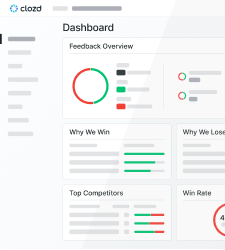
- Use dashboards (Clozd Platform, BI tools) to push insights in real time.
- Set up recurring reports or Slack integrations to keep teams aligned.
- Share verbatim quotes and decision-driver trends in leadership updates, product sprints, and enablement sessions.
Real-Time Analytics and Continuous Improvement
World-class revenue teams treat feedback as a live stream, not a retrospective. Companies with real-time reporting are more agile, responsive, and aligned.
- Automatically alert stakeholders when critical feedback arrives from top customers, key competitor losses, or major wins.
- Foster a culture of learning by sharing feedback in weekly team huddles or monthly business reviews.
- Revisit metrics quarterly and annually—course-correct as market norms and buyer expectations shift.
Customer Feedback Software & Tools for Every Journey Stage
To execute a best-in-class feedback program across all journey stages, you need technology that’s as robust as your goals.
Must-Have Features for Win-Loss and Retention:
- Multichannel Feedback Collection: Interviews (live, AI, asynchronous), surveys, product/usage analytics
- Automated Workflows: Enroll closed deals or implementation milestones into feedback programs automatically
- Integrated Analytics: Theme/tag extraction, dashboarding, segmentation by touchpoint or account
- Real-Time Alerts: Push insights to Slack, email, or within your CRM
- Secure, Role-Based Access: Democratize insights to sales, marketing, product, and executives
- AI-Augmented Insights: Rapid summarization, decision-driver detection, and competitive benchmark analysis
Choosing the Right Feedback Platform
- Look for AI-driven platforms (like the Clozd Platform) that allow you to scale interviews and surface actionable, deal-specific insights without bottlenecking your team.
- Ensure integrations with your CRM, business intelligence, and communications tools to eliminate silos and drive fast action.
- Prioritize solutions that blend expert services with technology—clients using Clozd’s interview-led programs consistently report double the satisfaction with the depth of their feedback and are 36% more likely to see ROI.
- Strong retention-focused tools offer pre-built scripts and workflows for win-loss, onboarding, and churn moments, ensuring you reach every customer at the right time in their journey.
Conclusion
Building a truly customer-centric growth engine doesn’t happen by accident—it’s the result of capturing rich, unbiased feedback at every key journey milestone and acting on it with discipline. The companies winning today (and tomorrow) rely on direct customer interviews and multi-channel feedback to outpace competitors, retain more clients, and earn loyalty.
Now’s the time to map your own customer journey, identify missed opportunities for direct feedback, and consider launching a structured program powered by expert-led interviews and the right technology. Your CRM isn’t the source of truth—your customer is. Let their voice be your compass for growth.
Ready to energize your business outcomes? Explore our guides, case studies, or get a demo to see how Clozd makes it easy to unlock the real reasons you win and lose.
Frequently Asked Questions About Customer Feedback Across the Buyer Journey
What are the most important customer journey touchpoints for collecting feedback?
The four most impactful touchpoints are Win-Loss, Post-Implementation, Ongoing Customer Experience (“Stay”), and Churn/Retention. These moments consistently deliver the highest ROI because they align feedback with real decisions—buying, adopting, renewing, or leaving.
Why isn’t CRM data enough to understand why deals are won or lost?
CRM data often reflects internal assumptions rather than buyer truth. Clozd research shows that up to 85% of closed-lost reasons in CRMs are inaccurate, and competitors are misidentified 65% of the time. Direct customer interviews uncover the real decision drivers that checkboxes miss.
What’s the difference between surveys and customer interviews?
Surveys are useful for trend detection and scale, but they lack depth. Interviews—live, asynchronous, or third-party led—provide context, emotion, and specificity, making them ideal for win-loss analysis, churn insights, and onboarding feedback. The strongest programs use both.
When should win-loss interviews be conducted?
Win-loss interviews should happen within 30 days of a buying decision while recall is fresh. Interviewing both customers and prospects who chose a competitor provides balanced insight into why you win, lose, and how you’re positioned in the market.
What is a “stay” interview, and why does it matter?
A stay interview is a proactive conversation with current customers to understand what’s working, where expectations aren’t being met, and whether churn risk exists. These interviews help organizations prevent churn before it happens and identify expansion opportunities.
How does post-implementation feedback improve retention?
Post-implementation feedback uncovers onboarding friction, adoption gaps, and unmet expectations early—typically at 30, 60, and 90 days. Addressing these issues improves product usage, strengthens relationships, and increases renewal likelihood.
Why use a third party to collect customer feedback?
Third-party interviewers remove bias and defensiveness. Clozd research shows customers—especially former customers—are significantly more candid when feedback isn’t collected by sales or account teams, leading to more actionable insights.
What metrics should be tied to customer feedback programs?
Key metrics include win rate, retention and churn, NPS, CSAT, product adoption, and renewal rates. Mature programs also track sales ramp time and competitive performance by segment.
How do high-performing companies act on customer feedback?
They integrate feedback into journey maps, share insights across teams, prioritize action items, and measure outcomes. Organizations that democratize feedback—making it visible beyond leadership—are significantly more likely to improve win rates and retention.
What should I look for in customer feedback software?
Look for tools that support interviews and surveys, automate workflows, integrate with your CRM and BI tools, provide real-time alerts, and use AI to surface themes and decision drivers. Platforms that combine technology with expert-led interviews tend to deliver stronger ROI.








.svg)