

Every company wins and loses deals—but not every company knows why. Without a clear understanding of what’s driving your wins and losses, you’re just guessing. And guessing isn’t a strategy.
That’s where win-loss analysis comes in.
Win-loss analysis gives companies the clarity they need to make smarter decisions about sales, marketing, product, and strategy. It replaces opinions with facts, helps teams understand their buyers’ real perspectives, and uncovers the truth behind every decision.
Read on to learn what win-loss analysis is, why it matters, and how to build a program that helps your company win more often.
Win-loss analysis is the process of capturing and analyzing feedback directly from your buyers to uncover the real reasons you win and lose sales opportunities. It’s the closest you can get to “game tape” for your business.
Just as elite sports teams review film to understand what worked and what didn’t, win-loss analysis helps organizations break down their past performance to improve future outcomes.
When done consistently, win-loss analysis helps you understand:
Win-loss analysis is about both identifying problems (so you can fix them) and uncovering repeatable success patterns.
Companies that implement formal win-loss programs consistently report tangible business benefits. Gartner research shows that organizations with a rigorous, ongoing win-loss analysis see up to a 50% improvement in win rate and a 15–30% increase in revenue. Even small improvements in win rate compound into major financial gains.
“Every professional sports team reviews their footage to understand where they need to improve. Winning deals is our sport, and Clozd is our video review. Everybody needs to be making every effort to get clients sharing feedback through their program."
—Ravi Kumaraswami, President of Worldwide Field Operations at Riskified
Your win-loss ratio (i.e., your win rate) measures the percentage of deals your company closes successfully out of all opportunities pursued within a given period. It’s one of the simplest—and most telling—metrics for understanding sales performance and overall go-to-market effectiveness.
Let’s start with the basic version:
Say your company had 200 total opportunities in a quarter. Out of those, you won 50 and lost 150. You would calculate your win rate like this:
(# of Won Deals / Total Opportunities) x 100 = Win Rate Percent
or from the example above: (50 / 200) x 100 = 25% Win Rate
While the simple formula shows how often you win, it doesn’t tell you how much revenue those wins represent. A weighted win rate gives you a better sense of revenue efficiency by focusing on the value of each deal rather than the count.
Let’s say your 50 won deals totaled $1,000,000 in revenue, and the 150 lost deals represented $3,000,000 in potential revenue. You can calculate your weighted win rate like this:
(Won Deal Value / Total Pipeline Value) x 100 = Weighted Win Rate Percent
or from the example above: ($1,000,000 / $4,000,000) x 100 = 25% Weighted Win Rate
In this case, your weighted win rate happens to match your deal count win rate—but that won’t always be true. If your team tends to win smaller deals and lose larger ones, your weighted win rate will be lower than your overall rate, signaling that you’re missing out on higher-value opportunities.
Calculating your win rate—both by deal count and by revenue—gives you a clear baseline to analyze trends:
Once you know these patterns, you can dig deeper with win-loss analysis to uncover the why behind the numbers—what differentiates your wins, where you’re losing, and how to increase both your frequency and value of closed-won deals.
Too often, teams base critical strategic decisions on assumptions, anecdotes, or internal data that’s incomplete—or flat-out wrong. CRM records often tell you what happened (deal closed lost, reason: price), but not why it happened.
In fact, research by Clozd shows that buyer and seller reasons for lost deals align only 15% of the time. That means 85% of your “win-loss data” is unreliable if it’s coming from your CRM alone.
Without real buyer feedback, companies:
When you start collecting feedback directly from buyers, everything changes. You get clarity about what’s driving outcomes, and your teams can finally act on truth, not speculation.
Here’s what consistent win-loss analysis reveals:
Armed with that information, your go-to-market teams can confidently adjust strategy, prioritize product investments, and build a unified approach to winning more often.
Win-loss analysis isn’t just informative—it’s transformative. When done consistently, it delivers measurable financial impact.
Even a small lift in your win rate can translate to millions in added revenue. For instance, a company with $10 million in quarterly pipeline and a 20% win rate would add $1 million in new revenue each quarter if their win rate improved by just two points. Over a year, that’s an additional $4 million.
That’s why 97% of companies that invest in win-loss programs plan to maintain or increase that investment in future years.
According to the our 2025 State of Win-Loss Analysis Report:

“It only takes us winning one deal to make Clozd worth it.”
—Rex Galbraith, CRO at Consensus
Beyond revenue, the benefits extend across your organization:
“If you're serious about optimizing your win-loss ratios and want data-driven insights to fuel your strategy, Clozd is a no-brainer. The upfront investment is quickly dwarfed by the immense value it brings in the form of actionable intelligence and competitive advantage.”
—Dan Bolton, Vice President of Corporate Marketing at Nitrogen
While some companies treat win-loss analysis as a periodic exercise—once or twice a year—the most successful ones treat it as an ongoing discipline.
The reasons buyers choose you (or your competitors) evolve constantly. Market conditions shift, competitors launch new features, buyer expectations change, and internal strategy moves in new directions. Without continuous feedback, you’re making tomorrow’s decisions with yesterday’s data.
Ideally, your company should:
If your deal cycle is long or highly seasonal, you may review data on an annual cadence—but feedback collection should never stop.
“We’re able to be key stakeholders in a lot of different projects by having our pulse on the market. The more we can deliver actionable insights and recommendations, the more helpful we are across the company.”
—Zahra Chithiwala, Group Product Marketing Manager at Headspace
Read the full Headspace case study.
An ongoing program creates a consistent stream of fresh insights. And when those insights are automated—through systems like the Clozd Platform—they become part of your company’s operating rhythm.
Before you reach out to buyers, start by analyzing your own records. Look at your CRM data from the last 12 months:
Even though CRM data isn’t perfect, it gives you a baseline to identify key patterns and segment your pipeline for deeper analysis.
This is where the real value begins. You can’t understand why deals are won or lost without asking the people who made the decision—the buyers themselves.
Clozd automates the entire feedback collection process—outreach, scheduling, incentives, transcription, and delivery—so your team can focus on applying insights rather than capturing them.
There are several channels to collect this feedback:
Each channel has its trade-offs. Live Interviews yield depth and accuracy, while AI Interviews provide scale. A balanced program typically uses both.
“Reps will seldom get true, honest responses as to why a deal was lost. Clozd steps in, acts as an unbiased third party, and walks through a detailed interview process with the client to know their reasoning. The detail we’ve received is outstanding.”
—Shivang Patel, Senior Director of Growth & Strategic Initiatives at FloQast
After collecting interviews, the next step is to identify your Decision Drivers—the key factors that influence whether you win or lose. These can include:
Each decision driver can be tagged as positive (helped you win) or negative (contributed to a loss). Over time, you’ll see which factors consistently drive outcomes and how they change across segments.
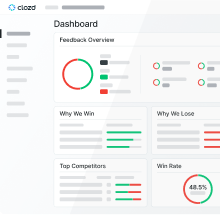
The Clozd Platform automatically categorizes and visualizes these insights, showing trending drivers, key quotes, and buyer sentiment. You can filter by competitor, region, or product line to drill deeper.
“I like that we can filter the dashboard by wins and losses, drill down into categories, and see verbatim feedback that makes the data really actionable.”
—Adella Jarvis, Senior Product Manager at Hopin
The real power of win-loss analysis comes when insights are shared and acted upon. Clozd makes this easy by automatically distributing new findings through Slack, CRM integrations, or email alerts.
Sales leaders can receive notifications when new interviews mention competitors or highlight performance issues. Product marketers can review feedback tied to feature requests or messaging themes. Executives can see summaries that tie directly to revenue impact.
Transparency ensures alignment—and turns feedback into action.
Win-loss analysis benefits every major team in your organization:
It’s a cross-functional discipline that builds organizational confidence and coordination.

“The entire leadership team is using win-loss insights—not just for sales or product, but also for customer success, engineering, and service. It’s matu red into how the market perceives our entire experience.”
—Deanna Ballew, SVP of Product, Acquia
Read the full Acquia case study.
Collecting data is only half the battle. The real value comes from sharing it broadly and acting on it.
Companies that distribute win-loss insights widely—without bottlenecks or censorship—achieve the greatest impact. According to Clozd research, 68% of companies that share win-loss insights across departments report an increase in win rate.
Use these best practices to operationalize your findings:
Clozd’s integrations with Slack and CRM tools make this simple—turning insights into real-time decision support for every team.
“I love the Slack integration. As interviews are added, they come through in real time, and teams can link directly to full interviews or dashboards in Clozd.”
—Heather Pepe, Senior Manager of Solutions Marketing at Calendly
A successful win-loss program isn’t about collecting data—it’s about measuring progress and driving improvement.
Track these key indicators over time:
The following case studies show that mature programs have a clear impact:
Ultimately, the goal isn’t just to collect data or generate reports—it’s to embed continuous learning into your company’s DNA.
When you build an ongoing win-loss program, you create a feedback loop that validates decisions, accelerates growth, and keeps your teams aligned around what truly matters: the buyer’s perspective.
You’ll start to see once-negative drivers turn into competitive strengths, and once-isolated insights turn into company-wide strategy.
“We took what used to be a reason we lose—and turned it into why we win.”
—Deanna Ballew, SVP of Product at Acquia
Win-loss analysis isn’t a one-time project, though. When done right, it’s a continuous, transformative process that keeps your company learning, adapting, and winning.
With the right partner, technology, and process, your win-loss insights can become one of your company’s most valuable strategic assets.

Learn more about how Clozd helps you uncover the real reasons you win and lose.
For other Win-Loss resources check out more Win-loss resources.
Companies that run ongoing win-loss programs typically see measurable revenue impact within the first year. According to industry benchmarks, organizations conducting consistent win-loss analysis for two years or more report an average 10–20% lift in win rate. Beyond new revenue, ROI comes from shorter sales cycles, improved competitive positioning, and fewer losses due to preventable misalignment between sales, product, and marketing.
Check out our ROI Calculator to see to how much you can increase your revenue through win-loss analysis with Clozd. Try it out for your whole pipeline or just a segment of your business. You can also connect with a Clozd win-loss expert to build out your own custom win-loss program and see what your specific ROI could be.
To create a simple win-loss chart, start by listing your closed opportunities for a given period with columns for outcome (won/lost), deal value, and key attributes like product, segment, or rep. Then use built-in chart options—such as a stacked bar chart or pie chart—to visualize your wins versus losses by category. You can also calculate your overall win rate with a basic formula:
(Won Deals ÷ Total Opportunities) × 100.
Adding filters for region, industry, or competitor gives you an instant visual of where you’re performing best.
A win or lose graph (sometimes called a win-loss chart) visually compares the number or percentage of deals won versus lost. It helps teams spot trends—like which products, segments, or competitors drive the most outcomes—without needing to read through long tables of data. Win-loss graphs are often used in sales reviews or QBRs to quickly summarize performance across time periods or teams.
A “good” win-loss ratio depends heavily on your industry, deal size, and market maturity. Many B2B companies aim for a win rate between 25% and 40%, though complex enterprise sales often land lower. What matters most is consistent improvement over time. If your ratio is 1:3 (one win for every three losses), the goal is to understand why you’re losing—and to move that ratio steadily upward through better qualification, messaging, and enablement.
Absolutely. A lost deal can be a win if it reveals insight that helps you close the next one. Win-loss interviews often uncover misalignment in messaging, unmet product needs, or buyer objections that can guide strategic improvements. In some cases, a “loss” also preserves valuable relationships or clarifies which customers are the wrong fit—saving time and money in the long run.
The win-loss factor refers to the set of elements that most influence whether a deal is won or lost—such as pricing, product capabilities, timing, brand perception, or sales process. By categorizing these factors during analysis, teams can identify which ones drive the biggest outcomes and where improvements will have the highest impact.
A win-loss ratio measures the relationship between your wins and losses. For example, a ratio of 1:3 means you win one deal for every three you lose—a 25% win rate. Interpreting it correctly means looking beyond the number: which types of deals are you winning, and which are you losing? Context matters. If you’re losing small, low-margin deals but winning your ideal customers, a lower ratio can still reflect healthy performance.
According to Gartner, win-loss analysis is the systematic process of capturing and analyzing feedback from buyers after a sales decision—both wins and losses—to understand decision drivers and improve go-to-market strategy. Gartner emphasizes combining quantitative CRM data with qualitative buyer interviews for the most complete insight into why deals are won, lost, or stalled.
You can calculate and visualize win-loss data using a range of tools—from simple spreadsheets like Excel or Google Sheets, to CRM data in platforms such as Salesforce or HubSpot. Many teams supplement this with customer interviews, surveys, or feedback platforms that reveal the reasons behind each outcome. Combining quantitative deal data with qualitative buyer insights gives you the most accurate view of performance. Platforms like Clozd automate this process by collecting structured feedback directly from buyers and integrating it into your analytics.