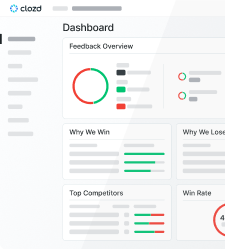



Most teams believe they know what their customers need, why they buy, why they stay, and why they leave. The data usually says otherwise.
Take one example. When Clozd compared CRM records from 1,000 closed-lost deals to what those buyers said in interviews, the loss reason recorded by the sales rep matched the buyer's account only 15% of the time. (See the full analysis.)
The same pattern shows up across the customer journey. Customer health scores may look fine right up until a customer cancels. Feature requests may not reflect what users actually struggle with. Messaging may sound right internally but not land with the market.
That gap is the reason customer interviews exist. Dashboards, surveys, and CRM fields tell you what happened. A well-run conversation tells you why.
Drawing on our experience of 60,000 prospect and customer interviews completed, this guide covers everything you need to run interviews that produce useful answers, whether you're shaping a product roadmap, testing a new market, improving onboarding, reducing churn, or understanding why deals are won and lost.
We’ll walk through the main types of interviews, a step-by-step process, the mistakes to avoid, and how to analyze customer interviews for actionable insights.
The Quick Version
If you only have a minute, here's how to run a customer interview:
- Set one clear objective. Know what decision the interviews will inform.
- Pick the right people. Include customers who left or said no, not just fans.
- Recruit with a short, specific ask. State the purpose, the time required, and how the feedback will be used.
- Choose a neutral interviewer. People are more candid with someone who didn't sell to them.
- Write an interview guide, not a script. Plan 8 to 12 open-ended questions and leave room to follow up.
- Ask about past behavior, not hypotheticals. "Tell me about the last time…" beats "Would you…?"
- Record, tag, and look for patterns. One interview is an anecdote; 20 or more is evidence.
- Share findings with the teams who can act. Each insight needs an owner.
The rest of this guide explains each step in detail.
What is a customer interview?
A customer interview is a one-on-one, open-ended conversation with a current, former, or potential customer, designed to understand their needs, decisions, and experiences in their own words. Unlike surveys, interviews let you ask follow-up questions and uncover the reasons behind someone's choices.
Customer interviews are a form of qualitative research. They don't produce statistically precise numbers the way a large survey does. What they produce is context: the trigger that started a buying process, the concern that never made it into a sales call, or the small frustration that slowly turned into a cancellation.
Here's how interviews compare with other common feedback methods:
| Method | Best for | Limitation |
|---|---|---|
| Customer interviews | Understanding why people make decisions; uncovering unknowns | Smaller samples; requires skilled interviewers |
| Surveys (NPS, CSAT) | Measuring sentiment across a large group | Low response depth; can't follow up on answers |
| Product analytics | Seeing what users actually do | Shows behavior, not motivation |
| CRM and sales notes | Tracking pipeline and outcomes | Filtered through the rep's perspective |
| Focus groups | Reacting to concepts as a group | Groupthink; loudest voices dominate |
The strongest research programs combine methods. Interviews explain the numbers your other tools produce. (For a deeper comparison, see why buyer interviews beat B2B surveys and what NPS, CSAT, and health scores miss.)
Why customer interviews matter
Customer interviews close the gap between what your team assumes and what your customers experienced. That gap is often wider than people expect.
Listen to Krisha Nair, VP of Marketing at StackAdapt talk about how they uncovered win-back opportunities once their team started interviewing their customers.
Internal data is filtered
CRM fields, health scores, and feature request logs all pass through someone's interpretation before you see them. A churn reason chosen from a dropdown, or a feature request summarized by a CSM, captures what someone thought the customer meant.
Behavioral data shows what, not why
Product analytics can tell you that users abandon a workflow at step three. Only a conversation reveals whether it's because the step is confusing, unnecessary, or blocked by a permission their IT team won't grant.
Customers soften the truth for the people they work with
A customer who is frustrated with onboarding rarely tells their CSM directly. A buyer who chose a competitor tells the rep "budget" or "timing" and moves on. A different interviewer, asking at a different time, gets a different answer.
Survey answers lack context
A customer can rate support a 6 out of 10, but only a conversation reveals that the real issue was a champion leaving the company and nobody stepping in to replace them.
When teams act on what they hear in interviews, the results show up across the business. The results are a better-prioritized roadmap, faster time-to-value, sharper messaging, fewer surprise cancellations, and higher win rates.
Types Of Customer Interviews
While the foundational interviewing process remains consistent across scenarios, the core variables lie in the choice of participant, the timing of the engagement, and the strategic decision the conversation is intended to inform.
| Interview type | Goal | Who to interview | When | Learn more |
|---|---|---|---|---|
| Market research and discovery | Validate problems, markets, messaging, and positioning | Target customers, prospects, and non-customers | Before building, launching, or entering a market | Market research with CRM contacts |
| Product research and feedback | Prioritize the roadmap; improve features and usability | Active users, admins, and decision-makers | Ongoing; before and after launches | Product research with customer feedback |
| Implementation and onboarding | Improve time-to-value | New customers and their implementation team | 30 to 90 days after go-live | Implementation interviews vs. check-ins |
| Mid-journey and relationship check-ins | Spot risks and expansion opportunities early | Established customers and executive sponsors | Mid-contract; ahead of renewal | Mid-journey customer feedback |
| Churn and retention | Understand why customers leave or stay | Churned, downgraded, and at-risk customers | Soon after cancellation; before renewal | Churn analysis |
| Win-loss | Understand why deals are won or lost | Buyers from recently closed deals, won and lost | Within weeks of the decision | Win-loss interviews |
Most customer interview guides focus on the first two types: discovery and product feedback with friendly users. Those are essential, but some of the most valuable conversations happen at other points in the journey. These include a new customer whose onboarding didn't match what they were promised, a long-time customer who quietly decided not to renew, and a buyer who evaluated you and chose someone else.
Those conversations are harder to get. The people involved may be frustrated, busy, or have little reason to help you. That makes recruiting and interviewer choice more important, which we cover below. It's also why many teams use the same interview approach across the entire customer journey rather than treating each type as a separate project. (See when and why to collect customer feedback at each stage.)
How to Conduct Customer Interviews Step-By-Step
1. Set a clear objective
Start with the decision the interviews should inform. "Learn about our customers" is too broad to guide your questions or your analysis. Objectives like these give you a focus:
- "Decide which of three roadmap bets matters most to enterprise admins."
- "Test whether our new positioning resonates with healthcare buyers."
- "Find out why customers who skip onboarding training churn at higher rates."
- "Understand why we're losing mid-market deals to Competitor X."
Next, decide whether you need breadth or depth. A broad interview explores a customer's whole experience and is good for surfacing things you didn't know to ask about. A focused interview goes deep on one topic, such as a feature, a pricing change, or a competitor, and is better for testing a specific hypothesis.
Write your objective down in one or two sentences and share it with everyone involved. It will keep your interview guide tight and your analysis honest.
2. Choose who to interview
Who you talk to shapes what you hear. A common mistake is interviewing only the customers who are easiest to reach, which usually means your happiest ones.
A balanced sample includes:
- Satisfied, long-term customers
- New customers who recently went through onboarding
- Customers who downgraded or left
- Buyers who evaluated you and chose a competitor
- Buyers who chose you over a competitor
In B2B, think beyond a single contact.Every account includes several perspectives: an executive sponsor, an admin, day-to-day users, and often procurement or IT. Each sees your product differently. Day-to-day users can tell you where the product slows them down. The executive sponsor can tell you whether it's delivering the outcome they paid for, and whether they plan to renew. The person your team talks to most may not be the one who makes the next decision. Where possible, interview the people whose views matter most for your objective, not just the most familiar contact.
For more on building your list, see how to select buyers for post-decision interviews and how to find the right interviewees for product research.
3. Recruit participants
Getting people to say yes is often the hardest part. Successful outreach is short and specific. Explain:
- Why you're reaching out, in one sentence
- How long it will take (30 minutes is a reasonable ask for most B2B interviews)
- How the feedback will be used, and whether it will be confidential
- What they get in return, such as a gift card, a charitable donation, or simply the chance to influence a product they use
It’s best to reach out while the experience is still fresh. For win-loss and churn interviews, that typically means within a few weeks of the decision.
Plan for more outreach than you think you need. Industry benchmarks for B2B interview participation typically fall between 15% and 30%, so completing 20 to 30 interviews often means contacting 100 to 200 accounts. Participation varies by audience.
For tactics that lift participation, see how to drive higher response rates for customer interviews.
4. Decide who will conduct the interview
This decision has more impact on the quality of your feedback than almost any other.
People are polite. When someone they've worked with asks for feedback, they tend to give a softened version of the truth. That's especially true when the honest answer involves the person asking. A CSM asking "how has onboarding gone?" is unlikely to hear "your team overpromised and underdelivered." A product manager asking about their own feature is unlikely to hear that nobody uses it.
You have three main options:
- Internal team members (product managers, researchers, CS leaders). These work well for exploratory product feedback with engaged customers. They risk bias when the interviewer has a stake in the answer.
- The account owner (sales rep or CSM). This is the most convenient option, but usually produces the least candid feedback, especially about onboarding, renewals, and lost deals.
- A neutral third party. This is best when candor matters most, such as with executive sponsors, at-risk or churned customers, and lost buyers. It also tends to increase participation.
You'll also need to decide whether the interviewer reveals which company they represent. That's the difference between blind and non-blind interviews. For a full breakdown of the tradeoffs, see DIY vs. third-party customer interviews.
5. Build your interview guide
An interview guide is a structured plan for the conversation, not a script to read word for word. A good guide keeps you on track while leaving room to follow interesting answers.
A simple structure for a 30-minute interview:
- Introduction (2–3 minutes). Thank them, confirm the time, explain how the feedback will be used, and ask permission to record.
- Context (5 minutes). Their role, their team, and what they were trying to solve.
- Core questions (15–20 minutes). The 5 to 8 questions most closely tied to your objective.
- Wrap-up (3–5 minutes). Open-ended closing questions and next steps.
Start by brainstorming every question you could ask. Then cut ruthlessly. Remove anything that can be answered with yes or no, anything that leads the witness, and anything that doesn't serve your objective. For a full walkthrough, see five steps to create an interview guide that actually gets answers.
6. Run the interview
This is where the quality of your research is won or lost. A few principles make the biggest difference.
Ask about past behavior, not future intentions. People are poor predictors of their own behavior. "Would you use a feature that did X?" invites a polite yes. "Tell me about the last time you needed to do X. What did you do?" gets you facts.
Listen more than you talk. Aim for the customer to speak for at least 80% of the conversation. Every minute you spend explaining or defending is a minute you're not learning.
Follow up on the interesting answers. The most valuable insight often comes from the second or third question on a topic. Simple prompts work well:
- "Can you tell me more about that?"
- "What do you mean by [their word]?"
- "Why was that important?"
- "What happened next?"
Dig beneath the first answer. Initial answers are often shorthand. For example, "The price was too high" might mean the buyer didn't see enough value, couldn't get budget approved, or was comparing you against a cheaper but narrower tool. Ask what they were comparing it to, and what would have made it worth the price.
Don't sell, defend, or fix. If a customer criticizes your product, resist the urge to explain the roadmap. Thank them, ask a follow-up question, and keep listening. The moment an interview turns into a pitch, candor drops.
Stay flexible. If the customer raises something important that isn't in your guide, follow it. The guide exists to make sure you cover the essentials, not to keep you from learning something unexpected.
7. Record and document
Always ask permission before recording. A recording lets the interviewer focus on the conversation instead of note-taking, and a transcript gives you a reliable record to analyze later.
If you're not recording, assign a separate note-taker. Interviewing and taking detailed notes at the same time almost always means doing both poorly.
Within an hour of the conversation, write a short summary: the three or four most important takeaways, any memorable quotes, and anything that surprised you. These summaries become invaluable when you're looking for patterns across dozens of interviews.
How to turn customer interview findings into action
Insight without action is just interesting. The most effective programs route each finding to the team that can do something about it.
| Team | What to look for in interviews | Example actions |
|---|---|---|
| Product | Missing capabilities, usability friction, unmet needs | Reprioritize the roadmap; fix onboarding gaps |
| Marketing | The language customers use; how they perceive competitors | Rewrite messaging; update positioning and battlecards |
| Sales | Where deals stall; what buyers valued in the sales process | Coach reps; refine demos and discovery |
| Customer success | Early warning signs; expectation gaps from the sale | Adjust onboarding; build retention plays |
| Leadership | Shifts in the market and competitive landscape | Adjust strategy, pricing, and investment |
A few habits help findings stick:
- Share quotes, not just summaries. A customer's own words are more persuasive than a slide of themes.
- Make findings easy to access. Insights locked in a research folder rarely change anything. See why you shouldn't silo your feedback data.
- Assign an owner and a deadline to each key finding.
- Measure the change. Track the metric you expect the action to move, whether that's win rate, retention, or time-to-value.
Example: Reputation’s customer success team kept running into “surprise churn,” where accounts with green health scores, high usage, and few support tickets canceled 30 to 60 days before renewal. Through more than 50 interviews with a neutral third party, several of their strongest-looking customers revealed frustrations they hadn’t shared with their CSMs, and some said they were planning to leave. The team used those findings to recalibrate their health scoring, sort accounts into high, medium, and low risk, and build “save” plays for at-risk customers. In one case, an interview flagged a critical bug frustrating a customer, and the team fixed it within two to three weeks and renewed the account. According to Reputation’s VP of customer success, that first save alone covered the full cost of their Clozd contract.
For a step-by-step framework, see how to turn interview data into actionable insights.
Building an ongoing customer interview program
A one-time research project gives you a snapshot. An ongoing program shows you how customer needs, competitors, and your own performance change over time, and catches problems before they show up in revenue.
Many companies start in-house and later bring in a partner to increase volume, improve candor, and free up their team's time. The Clozd Platform supports customer interviews at every stage of the journey, combining live interviews and AI-powered interviews with tools for analyzing and sharing what customers say. Teams use it for:
- Product research, to prioritize the roadmap with direct input from users and decision-makers
- Market research, to validate messaging, positioning, and new markets
- Onboarding and CX feedback, to improve time-to-value and catch risks early
- Churn analysis, to understand why customers leave or renew
- Win-loss analysis, to learn why deals are won and lost
To start building your own program, see how to build a customer feedback loop that drives action or talk to our team today.
This is where the quality of your research is won or lost. A few principles make the biggest difference.
Ask about past behavior, not future intentions. People are poor predictors of their own behavior. "Would you use a feature that did X?" invites a polite yes. "Tell me about the last time you needed to do X. What did you do?" gets you facts.
Listen more than you talk. Aim for the customer to speak for at least 80% of the conversation. Every minute you spend explaining or defending is a minute you're not learning.
Follow up on the interesting answers. The most valuable insight often comes from the second or third question on a topic. Simple prompts work well:
- "Can you tell me more about that?"
- "What do you mean by [their word]?"
- "Why was that important?"
- "What happened next?"
Dig beneath the first answer. Initial answers are often shorthand. For example, "The price was too high" might mean the buyer didn't see enough value, couldn't get budget approved, or was comparing you against a cheaper but narrower tool. Ask what they were comparing it to, and what would have made it worth the price.
Don't sell, defend, or fix. If a customer criticizes your product, resist the urge to explain the roadmap. Thank them, ask a follow-up question, and keep listening. The moment an interview turns into a pitch, candor drops.
Stay flexible. If the customer raises something important that isn't in your guide, follow it. The guide exists to make sure you cover the essentials, not to keep you from learning something unexpected.
Customer Interview FAQs
How long should a customer interview be?
Most customer interviews run 30 to 45 minutes. Thirty minutes is usually enough to cover 5 to 8 core questions with follow-ups, and it's an easier ask for busy B2B buyers. Longer sessions work for in-depth product research with engaged users.
How many customer interviews do you need?
For a single, specific segment, 20 to 30 interviews is usually enough to reach saturation, the point where new interviews mostly confirm themes you've already heard. Plan for more if you're comparing several segments. See the full sample size guide.
Should you pay customers for interviews?
An incentive often helps, especially for people who have no ongoing relationship with you, like lost buyers or churned customers. Gift cards and charitable donations are common choices. Check whether the participant's company has policies on accepting gifts.
What's the difference between a customer interview and a survey?
A survey asks many people the same fixed questions and is good for measuring how widespread something is. A customer interview is a live conversation with one person and is good for understanding why something happens. Most teams get the best results by using both.
Who should conduct customer interviews?
For product feedback with friendly customers, product managers and researchers work well. For sensitive conversations, such as interviews with lost buyers or churned customers, a neutral interviewer who wasn't involved in the relationship usually gets more candid answers. See DIY vs. third-party customer interviews.
When should you interview customers?
Tie interviews to the moments that matter most for your objective: before you build or launch something, 30 to 90 days after a customer goes live, ahead of renewal, and soon after a customer cancels or a buyer makes a purchase decision. For any interview about a specific event, reach out within a few weeks, while the experience is still fresh.
Can AI conduct customer interviews?
AI interviewers can now run structured conversations, ask follow-up questions, and collect feedback at a scale that's hard to match with live interviews alone. They're well suited to reaching more customers, such as mid-market and SMB accounts. Live interviews with experienced interviewers still tend to go deeper on complex, high-stakes decisions. Many programs use both.