
Hero background

Clozd MCPCustomer truth, built into your AI

AI is changing how businesses make decisions—but it’s only as powerful as the data behind it. With the Clozd MCP, your AI workflows are now grounded in real customer truth.

Talk with us
Connects to the AI tools your team already uses
MCP explained

Model Context Protocol: 
Connect your data to AI

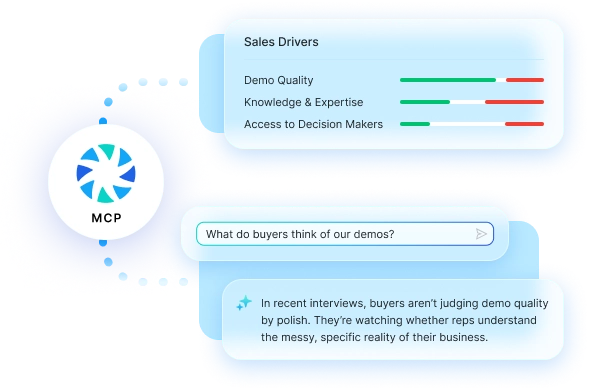
MCP is an open standard that allows AI tools to safely access live external data. Think of it as a secure bridge between Clozd and your AI assistant. Clozd MCP makes real buyer feedback available inside the tools your team already uses.

Connect Background
Connecting MCP

Connect in four easy steps

1

Pick your AI tool

Choose a client you'd like to use—Claude, ChatGPT, Windsurf, Gemini, or another AI assistant.

2

Add the Clozd MCP server

Contact your AI admin to add the Clozd MCP—so you can connect and securely access your customer feedback.

3

Sign in with your identity provider

Authorize with your identity provider. Your admin scopes which programs the AI tool can see.

4

Start asking questions

Connect your customer insights with the everyday tools your team and agents already use.

Click for more details
Proven prompts

You're connected—now let's get started

Try these curated prompts to help every GTM team get value from Clozd MCP from day one.

Sales
Marketing
CS
Product
Executive

Competitive prep in minutes

Summarize the top reasons we lost to our top competitor set in the last 90 days and pull two representative customer quotes I can use in prep.

Objection pattern review

Which objections come up most often during evaluation, and which ones correlate most strongly with losses? Include examples and suggested talk tracks.

Demo quality readout

Pull buyer quotes about demo quality and summarize what the best demos had in common versus the ones that failed to build confidence.

No-decision recovery scan

List deals marked “no decision” and summarize the common reasons buyers stalled, delayed, or walked away.

Sales execution audit

Which deals cite sales responsiveness or follow-through as a positive factor, and what specifically did reps do that built confidence?

Lost-momentum review

Which deals cite sales responsiveness or follow-through as a negative driver, and what specifically went wrong in the process?

Price ceiling moments

Find examples of pricing resistance involving finance or procurement and summarize the thresholds or concerns buyers mentioned.

Evaluation activity analysis

Which sales activities—like demos, pricing calls, or technical deep dives—are mentioned most positively by buyers, and why?

Messaging gap scan

What messaging gaps appear most often in recent interviews, and which competitor narratives seem to benefit from them?

Pricing theme breakdown

How does pricing show
up in losses? Break
it into themes like
too expensive,
packaging friction,
budget freezes, and
unclear ROI.

Decision maker analysis

Summarize buyer perceptions of our positioning and brand, then show which personas most often act as decision-makers versus influencers.

Packaging friction review

Summarize buyer feedback on packaging and add-on structure, and explain how it affects evaluation momentum and deal outcomes.

Industry message map

Which deals cite sales responsiveness or follow-through as a positive factor, and what specifically did reps do that built confidence?

Standalone vs. suite narrative

Summarize why buyers choose all-in-one platforms versus standalone solutions, and identify which narrative appears to resonate most often.

Outcome proof extraction

Extract the strongest
customer proof points
from buyer feedback,
including time saved,
risk reduced, revenue
impact, and outcomes
that support messaging.

Trend monitor

What buyer themes have increased in frequency this quarter, and which should shape the next messaging update or campaign narrative?

Renewal risk signal scan

Summarize the top themes in at-risk renewals and highlight the earliest warning signs CS teams should watch for.

Onboarding friction review

What implementation or onboarding issues come up most often, and which appear to have the biggest downstream impact on satisfaction or retention?

Expectation gap analysis

Find examples where expectations set during the sales process did not match the post-sale experience—and then group those gaps into clear themes.

Adoption blocker summary

Which product, process, or team-related blockers most often slow adoption after kickoff, and how do customers describe the impact?

Expansion finder

Identify accounts where customers express unmet needs, adjacent use cases, or positive momentum that could indicate expansion opportunities.

Value realization evidence

Pull customer quotes showing measurable value, successful outcomes, or meaningful wins that I can use in renewal prep or executive reviews.

Churn driver breakdown

Summarize the top reasons customers churn, separate preventable from non-preventable themes, and call out the patterns that appear most often.

QBR prep from customer voice

Summarize what [insert segment] cares about most, where they see value and experience friction. Include quotes that strengthen QBR narrative.

Product gap summary

Identify the most common product capability gaps mentioned in losses and group them into themes with representative examples.

Ease-of-use signal review

Show where buyers describe the product as intuitive versus complex, and summarize which workflows or features drive those perceptions.

Integration and API pressure test

Which integrations are requested most often, which missing integrations are tied to loses, and what do buyers say about the API experience?

UI and UX impact review

Summarize buyer feedback on the user experience and whether it helps outcomes, slows adoption, or creates confusion.

Reporting sentiment

Pull buyer quotes about reporting, exports, and access to customer data, then summarize the sentiment behind each theme.

Feature perception

Which features are praised most often, and which receive the most criticism? Group them by theme and frequency.

Win-side strengths

What product strengths most often contribute to wins, and which buyer quotes best explain the value behind those decisions?

Loss-side product drivers

What product-related factors contribute most often to losses, and which themes appear most urgent for roadmap or enablement attention?

Quarterly theme brief

Compare win drivers versus loss drivers from the last six months and identify the biggest gaps we should address first.

Change-over-time review

Summarize how loss themes changed in the last three months compared to the prior three months, and highlight any emerging themes.

High-value deal inspection

Show the largest deals we won and lost in the last year, summarize the decisive factors in each outcome, and flag patterns leadership should act on.

Segment win-rate breakdown

Break down win rate by segment and highlight where we see the strongest drivers, weakest drivers, and clearest path to improvement.

Decision-driver leaderboard

Show the top ten most-cited decision drivers overall, including frequency, direction, and a representative quote for each.

Expansion and retention scan

What are the top drivers of retention, churn, and expansion? Separate value realized, new use cases, and packaging themes.

Regional and tier performance

Are there specific company tiers or regions where we lose more often? Break down outcomes and summarize the main drivers behind them.

Sales cycle pressure test

What is the average sales cycle length for wins versus losses, and which drivers correlate most strongly with longer cycles?

MCP Tools background
Available tools

Here’s what you can access with Clozd MCP

Query buyer feedback, deal outcomes, Decision Drivers, competitor trends, transcripts, and more—directly from your Clozd data.

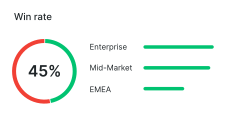
Programs & win rates

Start with your available Clozd programs, then measure win-loss performance across them.

/get_programs

/get_win_rates

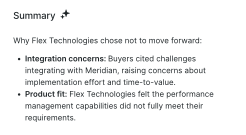
Deals & responses

Pull deal records, customer responses, summaries, and transcripts.

/get_deals

/get_responses

/get_response_summaries

/get_transcripts

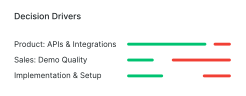
Decision Drivers

See what drives wins and losses—including themes, sentiment, supporting quotes, and trend counts.

/get_decision_drivers

/get_decision_driver_counts

/get_decision_driver
_categories

/get_decision_driver_category
_counts

/get_driver_quotes

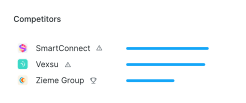
Competitive insights

Track competitor frequency and understand which factors help or hurt against specific competitors.

/get_competitors

/get_competitor_sentiment
_drivers

Gong signals

See what Gong conversations reveal and compare those patterns with the drivers identified in Clozd interviews.

/get_gong_drivers

/get_gong_driver_counts

/get_gong_driver
_categories

/get_gong_driver_category
_counts

/get_gong_driver_overlap

Tags & metadata

Use tags, deal associations, usage trends, and flagged deal types (like win-back opportunities) to add more context to your analysis.

/get_tags

/get_awe_deals

FAQs
Can I access multiple Clozd programs at once?
Yes. The Clozd MCP can pull data from any programs within an organization. The customer will need to specify from which programs data should be queried. Data is pulled from one program at a time.
Do my Clozd role permissions carry over to the MCP?
Yes. Role-based permissions set in the Clozd Platform apply directly to MCP access. If a user can only view certain programs or data in Clozd, those same restrictions are enforced through the MCP connection—with no additional configuration required.
Is Clozd MCP audit-ready for enterprise security teams?
Yes. Connections, sessions, and access events are logged for security review. Authentication runs through OAuth 2.0 and SSO—no API keys, no local credentials. Clozd MCP is built to meet enterprise security expectations out of the box.
Can I add MCP to providers besides those listed above?
Yes. MCP is an open standard, so any AI tool or platform that supports custom MCP connections can connect to it. The Clozd MCP server is not limited to the AI tools listed above.
Talk with us